
On January 7, 2025, from 12:00 pm – 1:00 pm EST, the Quincy Institute and the Asia Society of Northern California will be hosting a discussion on “Re-Kindling the U.S.-China S&T Relationship: Challenges and Opportunities.” The program will feature Prof. Denis Simon, Prof. Caroline Wagner, and me. Marcus Stanley of the Quincy Institute will moderate. Here’s the link to register: https://quincyinst.org/events/re-kindling-the-u-s-china-st-relationship-challenges-and-opportunities/.
Quincy recently published an article I co-authored with Denis Simon on “Bridging the Divide: It’s Time for a New Science Agreement with China.” This discussion is also a sequel to the August 13, 2023, program I hosted at Berkeley, “ Renewing the US-China STA is Not the Question.”
I have long advocated for continued S&T cooperation under a modernized agreement with better oversight. In 2016, I urged the USPTO to dissent from renewing the Science & Technology Agreement unless it was updated. The Governmental Accountability Office soft-pedaled my dissent by stating, “The U.S. Patent and Trademark Office has identified a potential discrepancy between Chinese law and the bilateral Science and Technology Agreement.” This “potential discrepancy” involved a key issue of forced Chinese ownership of technology improvements developed in bilateral cooperation. The problem was ultimately resolved in a WTO case filed by the United States and joined by many other countries.
According to a State Department press release, the new agreement “establishes new guardrails for implementing agencies to protect the safety and security of their researchers, and advances U.S. interests through newly established and strengthened provisions on transparency and data reciprocity. “ My assumption is that the new agreement is legally incapable of delivering on most, if not all, these issues as they arise from similar “legal discrepancies.” The new agreement can neither alter Chinese law nor bind other government agencies. However, the text has not yet been publicly released.
A second consideration concerns oversight. Earlier in 2024, the USPTO responded to a request from Congress to detail the number of patents granted due to bilateral science cooperation. The response from the USPTO disclosed 1020 patents granted from 2010-2024. When I was at USPTO back in 2017, we found (as I recall) approximately 400 patents granted in the United States arising from collaborative US government-funded research. A small cohort of these patents raised concerns about the misappropriation of US technology. Data of this type, including information on co-authored scientific publications, should be routinely made available to better enable oversight of bilateral agreements with all countries. In this instance, the problem of evaluating the S&T agreement appears to rest with the US government’s lack of transparency and a wavering commitment to oversight.
Republican lawmakers have responded negatively to the renewal of the S&T Agreement. Will Donald Trump invoke the revocation provisions of the revised agreement, or will he acquiesce in its renewal? The last renewal in 2018 occurred under his watch. Given the information released to date, it is difficult to say how problematic the agreement may be. One alternative is to release the current version and update its oversight and review. Such a process could benefit US-China relations and other bilateral science and technology agreements. The former deal not only needed updates in addressing security risks, but it also required an update to a more modern version of protecting IP and other intangible properties, including data, databases and privacy, genomic inventions, protection of traditional knowledge (such as traditional Chinese medicine), protection of genetic resources, software patenting, and fintech. Finally, it is hoped that the current agreement will help to energize bilateral cooperation on global issues such as climate change and health, which require the collaboration of the two scientific superpowers.
If you are interested in data-driven approaches to understanding how to evaluate technological opportunities and challenges with China, please sign up for the workshop Asia Society will host on February 4, 2025 in San Francisco.
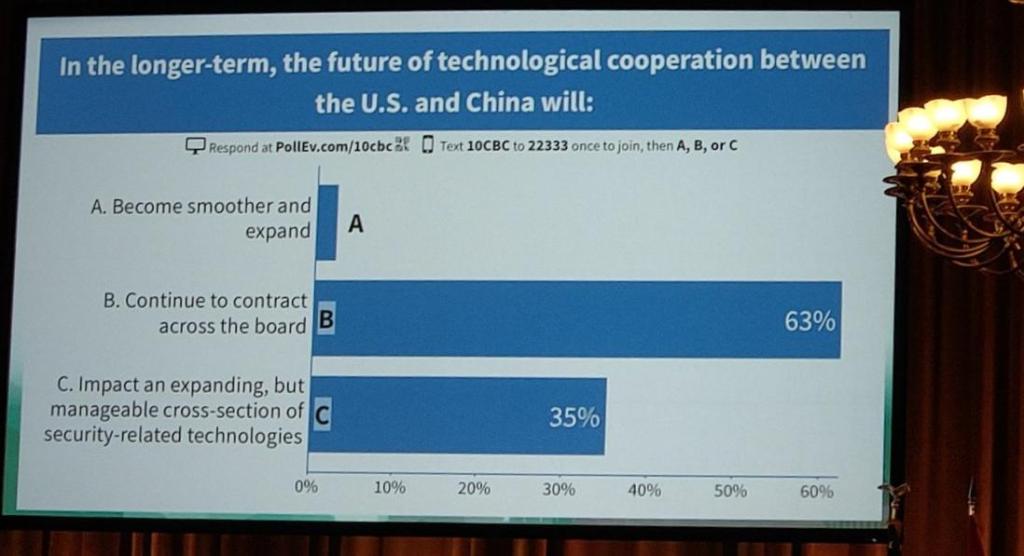
Photo: From a May 2019 seminar on US-China science collaboration. What would a survey reveal today? Please send me your comments!
Categories: China IPR

 China IPR - Intellectual Property Developments in China
Thanks, Mark. I’ve registered. Jim
James Pooley A Professional Law Corporation http://www.pooley.com http://www.pooley.com/ Mail: 325 Sharon Park Dr., #208 Menlo Park, CA 94025 Phone: +1 650 285 8520
Please visit http://www.whyscoutingmatters.com http://www.whyscoutingmatters.com/
>
LikeLike