
- The Immediate Issue: Semaglutide and the Courts
Recently, the Supreme People’s Court of China (SPC) upheld a decision of the Beijing Intellectual Property Court reversing a China National Intellectual Property Administration (CNIPA) invalidation decision and confirming the validity of Novo Nordisk’s semaglutide compound patent. Although the final written decision has not yet been publicly released, official summaries indicate that the court accepted post-filing experimental data where “the technical effect can be derived from the original specification” (技术效果可由原说明书得出), reversing an administrative invalidation decision. Public reporting further indicates that the dispute turned on whether CNIPA would accept post-filing experimental data demonstrating semaglutide’s surprising pharmacokinetic effects in animal models, where the application as filed contained no experimental data. Sources: China Patent Strategy (Eagle IP), “Beijing Supreme People’s Court Upholds Novo Nordisk Semaglutide Patent in China based on Post-Filing Data,” https://chinapatentstrategy.com/beijing-supreme-peoples-court-upholds-novo-nordisk-semaglutide-patent-in-china-based-on-post-filing-data/; see also MOFCOM IP Case Library (searchable), https://ipr.mofcom.gov.cn/.
This outcome reflects the resolution of an issue that has occupied Chinese patent examination, adjudication, and U.S.–China engagement for more than two decades.
- Article 26.3, the Patent Examination Guidelines, and Retroactivity
This recent dispute over post-filing data first arose largely from successive revisions to China’s Patent Examination Guidelines (PEG) interpreting Patent Law Article 26.3 on sufficiency of disclosure. A 2013 training slide of mine captured the arc succinctly:
“According to the 1993 examination guidelines, patent applicants were allowed to supplement their applications after the date of filing with data showing ‘use and effect’ of the chemical compound, as long as the supplement meets the requirements of Article 26.3 of the Patent Law. However, subsequent amendments to the examination guidelines in 2006 appeared to have narrowed this considerably so that supplemental data was no longer allowed. In a new chemical compound invention, the SIPO examination guidelines now require that the specification provide proof that the claimed compounds have certain biological activity. No post-filing data is accepted to show that the claimed compound has certain biological activity.”
The most consequential problem was temporal rather than doctrinal. As also noted at the time:
“In invalidation proceedings, SIPO’s Patent Review Board (PRB) is applying the newest examination guidelines on sufficiency of disclosure to cases with priority dates of 2000 and earlier. Submission of post-filing data is not permitted under the new guidelines, thus application of the new guidelines to old cases retroactively deprives applicants of the chance of securing patent rights.”
- The Law on Legislation and Non-Retroactivity
This retroactive tightening raised a basic legality concern under China’s Law on Legislation (立法法, 2000) (LoL), which embodies a general principle of non-retroactivity when new legislation restricts previously available rights. Article 84 provided:
“Laws, administrative regulations, local regulations, autonomous regulations, separate regulations, and rules shall not have retroactive effect, except where special provisions are made to better protect the rights and interests of citizens, legal persons, and other organizations.”
In practical terms, the argument was straightforward. Even if the PEG were later tightened, CNIPA (then SIPO) could not lawfully apply those tighter rules to previously filed pharmaceutical patent applications. This framing shifted the debate away from abstract patentability standards and toward a concrete issue of domestic legality. The case especially affected any number of pharmaceutical patents that had been applied for under more favorable PEG standards than were currently in existence at the time of examination.
Although this slippage into previous examination standards also raised potential WTO concerns regarding backsliding in non-tariff commitments made at accession, the argument advanced here relied on China’s own domestic legal framework. I also informed SIPO that this issue regarding the Law on Legislation reflected language specific to China; the United States has no comparable general prohibition on non-retroactivity of legislation restricting rights, even if such a provision might offer greater predictability for intellectual property protection.
- December 2013: Anchoring Post-Filing Data to Domestic Law
That domestic-law framing was explicitly reflected in December 2013, in connection with then Vice President Biden’s visit to China and later the 24th meeting of the Joint Commission on Commerce and Trade (JCCT). I took a lead role in negotiating both commitments.
The White House Joint Fact Sheet dated December 5, 2013 stated: “China affirms that the Chinese Patent Examination Guidelines permit patent applicants to file additional data after filing their patent applications, and that the Guidelines are subject to Article 84 of the Law on Legislation, to ensure that pharmaceutical inventions receive patent protection. China affirms that this interpretation is currently in effect.” Source: White House Joint Fact Sheet, https://obamawhitehouse.archives.gov/the-press-office/2013/12/05/joint-fact-sheet-strengthening-us-china-economic-relations.
The 24th JCCT Outcomes dated December 20, 2013 went further by addressing court practice: “China re-affirms that the Chinese Patent Guidelines permit patent applicants to file additional data after filing their patent applications, and that the Guidelines are subject to Article 84 of the Law on Legislation to ensure that pharmaceutical inventions receive patent protection. China affirms that this interpretation is currently in effect for patent examinations, re-examinations, and representations before the Courts.” Source: 24th JCCT Outcomes, https://ustr.gov/about-us/policy-offices/press-office/fact-sheets/2013/December/JCCT-outcomes.
As best I could recall, I could not include a commitment to have the courts also consider accepting post-filing supplementation of data in the meetings I held with Vice President Biden’s delegation, as the courts were not present at the meeting. Only SIPO attended those negotiations, not the courts.
- Training, Dialogue, and Judicial Engagement
Following the 2013 outcomes, the issue continued to be addressed through technical exchanges, training programs, and judicial dialogue, rather than solely through trade negotiations. These activities also included meetings with the Beijing Intellectual Property Court in July 2015, where post-filing data, Article 26.3, and differences between examination and adjudication were discussed as “hot issues” in pharmaceutical cases.
These activities also included judicial exchange and commercial rule-of-law programs involving U.S. and Chinese courts, with participation by individual U.S. judges, including former Chief Judge Randall R. Rader of the U.S. Court of Appeals for the Federal Circuit. Source: my blog, “U.S.–China Conclude High-Level Exchange on Judicial Reform and Commercial Rule of Law,” https://chinaipr.com/2016/08/06/us-china-conclude-high-level-exchange-on-judicial-reform-and-commercial-rule-of-law/.
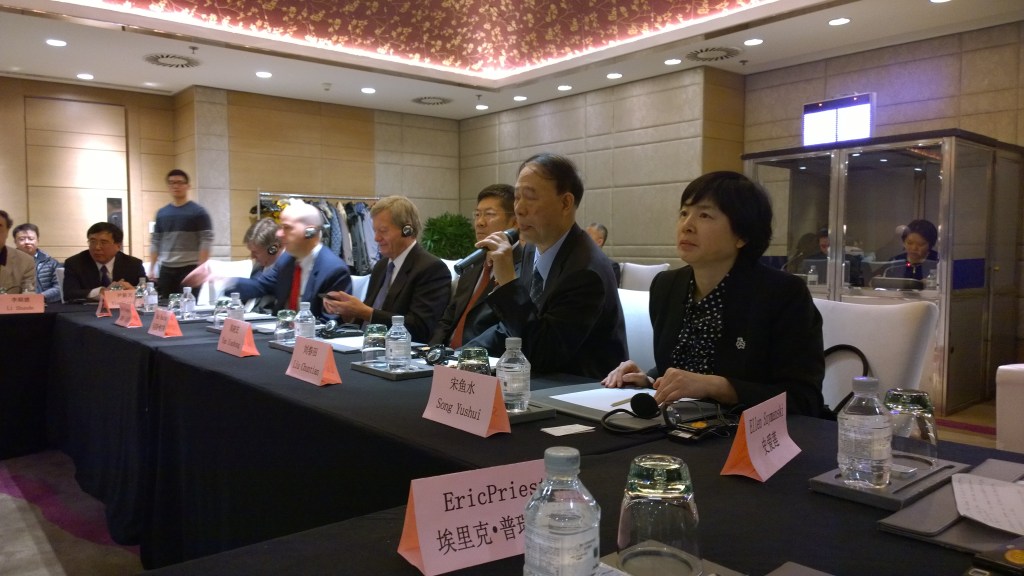
In parallel, the U.S.–China IP Cooperation Dialogue, hosted by the U.S. Chamber of Commerce and Renmin University, engaged repeatedly on pharmaceutical patent issues, including post-filing supplementation of data to ensure patentability. Participants included Hon. David Kappos, Chief Judge Randall Rader, Prof. Eric Priest, Tony Chen of Jones Day, me, and others. The 2016 Dialogue report noted that draft amendments to the Patent Examination Guidelines would allow submission of supplemental data for pharmaceutical patent applications, bringing China closer to best practices at other major patent offices.
This period of sustained legal and technical engagement also coincided with a broader policy shift inside China toward encouraging innovative pharmaceuticals, articulated most clearly by then China Food and Drug Administration Commissioner Bi Jingquan, who assumed office in 2015. Beginning around that time, Commissioner Bi emphasized the need for China’s drug regulatory system to move away from reliance on generics and toward supporting innovative drug development, including through stronger and more predictable intellectual property protection. As discussed previously on my blog, these reforms reflected growing recognition within China that innovative pharmaceuticals require credible patent protection and regulatory coordination to attract investment and support outbound licensing. This is particularly critical for biologics and complex pharmaceuticals where the full range of a compound’s characteristics may not be known until after the patent is filed and thus requires post-filing supplementation of data. Sources: https://chinaipr.com/2017/05/07/chinas-drug-regulatory-reforms-a-turning-point-for-innovative-pharmaceuticals/; https://chinaipr.com/2017/10/15/cfda-reforms-and-the-impact-on-pharmaceutical-ip/.
- Phase One and Subsequent Implementation
The Phase One Economic and Trade Agreement between the United States and China, signed on January 15, 2020, addressed post-filing supplementation of data explicitly. Article 1.10 provided that China “shall permit pharmaceutical patent applicants to rely on supplemental data to satisfy relevant requirements for patentability, including sufficiency of disclosure and inventive step, during patent examination proceedings, patent review proceedings, and judicial proceedings.” Source: Phase One Agreement, https://ustr.gov/sites/default/files/files/agreements/phase%20one%20agreement/Economic_And_Trade_Agreement_Between_The_United_States_And_China_Text.pdf.
Phase One was not a treaty under Chinese law and was not directly incorporated into domestic legislation. Its impact therefore depended on subsequent implementation through judicial interpretations and administrative practice.
One important area of implementation was the courts. Article 10 of the SPC Provisions on Several Issues concerning the Trial of Administrative Cases involving the Granting and Confirmation of Patent Rights (I), effective September 12, 2020, provides that where a pharmaceutical patent applicant submits post-filing experimental data to prove that the patent application satisfies the requirements of Article 22.3 of the Patent Law and Article 26.3 as implemented through the Patent Examination Guidelines regarding adequate sufficiency of disclosure and post-filing supplementation, the people’s court shall examine such data. Source: SPC Judicial Interpretation (I), https://policy.mofcom.gov.cn/claw/clawInfo.shtml?id=87120.
CNIPA subsequently revised the Patent Examination Guidelines effective January 15, 2021. Section 3.5.1 provides that for experimental data submitted after the filing date to satisfy the requirements of Article 22.3 and Article 26.3 of the Patent Law, the examiner shall examine such data, provided that the technical effects demonstrated by the supplementary experimental data are those that a person skilled in the art can obtain from the disclosure contained in the original application. Source: CNIPA Patent Examination Guidelines (2021), https://www.cnipa.gov.cn/art/2020/12/14/art_74_155606.html.
- Concluding Observations
The SPC’s recent handling of post-filing supplementation of data did not result from a single agreement or a single pressure point. Rather, it reflects the cumulative effect of reliance on China’s own domestic law, sustained technical and judicial engagement, industry participation, and later trade-related pressure applied once a legal and institutional foundation had been laid.
At the same time, implementation remains uneven. Industry groups, including PhRMA, have noted that despite revisions to the Patent Examination Guidelines and judicial interpretations, further reforms are needed to ensure clear, consistent, and coherent standards regarding acceptance of post-filing data in China, particularly in invalidation proceedings. Of course, greater transparency in court decisions would assist tremendously in confirming China’s implementation of its many commitments in this area. Source: PhRMA comments on Phase One compliance, https://comments.ustr.gov/s/commentdetails?rid=K922WRB7MK.
Update of February 4, 2026. In the official Chinese Legal Daily just published a long editorial reviewing the achievements of Supreme Court IP Court. there is a paragraph on this semaglutide case with quotes from Judge CUI Ning. “On December 31, 2025, the IP Court of the Supreme People’s Court delivered a final judgment on the highly closely watched administrative dispute case over the invalidation of the compound patent for semaglutide, rejecting the appeals of several domestic generic pharmaceutical enterprises and clarifying the reasonable acceptance criteria for supplementary experimental data in pharmaceutical patents. “Pharmaceutical R&D is characterized by high investment and long development cycles, and the determination of experimental data in patent examination shall follow a prudent standard that aligns with industry practices,” explained Judge Cui Ning, the case-handling judge, regarding the judicial reasoning behind the judgment. The court held that the key to determining the admissibility of supplementary data is whether the patent specification has provided a preliminary and credible basic record for the claimed technical effects. In this case, the original specification had clearly set forth a definite technical direction and a verifiable research approach; the subsequent supplementary data served to further confirm and elaborate on the aforesaid technical contribution, rather than constituting an entirely new technical solution, and thus should be taken into account in the patent examination. This judgment not only upholds the right of original research pharmaceutical enterprises to obtain reasonable returns within the patent protection term and incentivizes original innovation in the pharmaceutical sector, but also delineates a clear and reasonable boundary for generic pharmaceutical enterprises to challenge defective patents by clarifying uniform judicial adjudication rules.”

 China IPR - Intellectual Property Developments in China