
China has become very good at meeting IP metrics. The distinctive aspects of China’s IP system suggest that comparative ranking systems need to think harder about which metrics are worth measuring, and which ones can be gamed or simply misunderstood in order to accurately judge China’s IP system.
There are various ways to measure China’s IP system, not all of which are easy to compare with other systems. These include China’s IP-related Five-Year Plans and goals, WIPO’s Global Innovation Index, the U.S. Chamber of Commerce’s 2026 International IP Index, government plans such as the USPTO work plan, and less IP-focused indicators, such as the World Justice Project Rule of Law Index. These measure different things, are released on different cycles, have different policy impacts, and have different relevance to China.
The Global Innovation Index, typically released each September by WIPO, emphasizes measurable innovation outputs. It ranked China 10th globally in its 2025 edition. The U.S. Chamber’s International IP Index, released on March 11, 2026, focuses on legal and commercial IP conditions. It ranked China 25th of 55 economies, with essentially no forward movement since last year. The World Justice Project Rule of Law Index, released in October 2025, evaluates broader institutional rule of law characteristics. These results are not necessarily inconsistent, except when they are measuring similar things but calculate or weigh them differently.
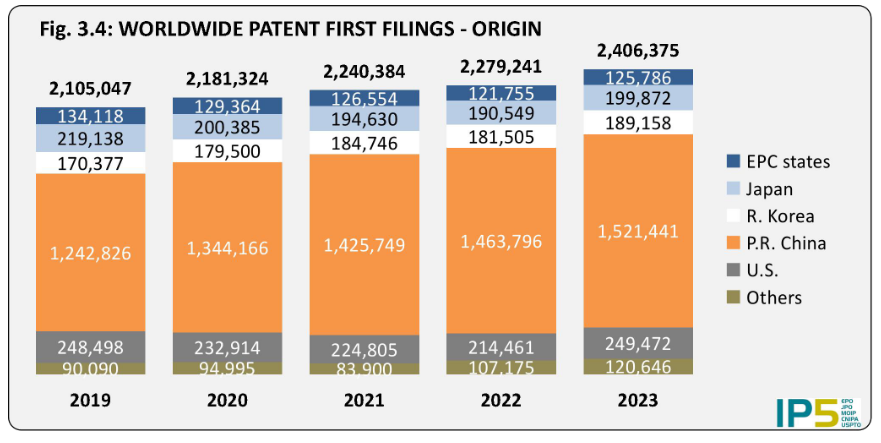
One common distortion to many of these IP indices is that they rely heavily on the numbers of patent and trademark filings, which is more easily measurable. They therefore tend to underreport on qualitative measurements. In recent years, China has moved away from this easily measured index in favor of qualitative measures, such as patents in force or commercialized rights. Foreign indices and observers might consider doing likewise.
This shift to measuring quality began to take place after Xi Jinping’s influential article in the leading party journal Seeking Truth (求是) in 2020, which mentioned IP quality 11 times. For example, by the end of 2025, China reported 16 high-value invention patents per 10,000 people, above the target of 12. China also reported 6.318 million valid invention patents, 4.206 million trademark registrations in 2025, 50.816 million valid registered trademarks, 78,000 PCT applications, and 1.458 million patent transfer and license recordals. China also reported that patent-intensive industries accounted for 13.38 percent of GDP in 2024. The next planning cycle is already pointing toward at least 22 high-value invention patents per 10,000 people by 2030. At the same time, we do not yet have a fully articulated new set of detailed empirical IP indicators for the next planning cycle. Based on prior practice, those more granular targets are likely to emerge over the coming year as the next plan is operationalized.
Another oft-neglected issue in analyzing Chinese patent data is comparability. When different reporters or academics count “patents,” they also need to be counting the same rights. China distinguishes among invention patents, utility models, and designs. The United States relies primarily on utility patents (which in China are called invention patents), alongside design patents and plant patents. A legitimate question is whether different analysts are using the same basket of rights. Aggregating China’s utility model patents with invention patents can exacerbate a perception of a hyper-patenting trend in China. Qualitative overlays on China’s patent data, including patents in force or even filings made at the end of the year to utilize subsidies or satisfy quotas, can also be helpful in addressing qualitative concerns.
China has become very good at meeting IP metrics. The distinctive aspects of China’s IP system suggest that comparative ranking systems need to think harder about which metrics are worth measuring, and which ones can be gamed or simply misunderstood in order to accurately judge China’s IP system.
There are various ways to measure China’s IP system, not all of which are easy to compare with other systems. These include China’s IP-related Five-Year Plans and goals, WIPO’s Global Innovation Index, the U.S. Chamber of Commerce’s 2026 International IP Index, government plans such as the USPTO work plan, and less IP-focused indicators, such as the World Justice Project Rule of Law Index. These measure different things, are released on different cycles, have different policy impacts, and have different relevance to China.
The Global Innovation Index, typically released each September by WIPO, emphasizes measurable innovation outputs. It ranked China 10th globally in its 2025 edition. The U.S. Chamber’s International IP Index, released on March 11, 2026, focuses on legal and commercial IP conditions. It ranked China 25th of 55 economies, with essentially no forward movement since last year. The World Justice Project Rule of Law Index, released in October 2025, evaluates broader institutional rule of law characteristics. These results are not necessarily inconsistent, except when they are measuring similar things but calculate or weigh them differently.
One common distortion to many of these IP indices is that they rely heavily on the numbers of patent and trademark filings, which is more easily measurable. They therefore tend to underreport on qualitative measurements. In recent years, China has moved away from this easily measured index in favor of qualitative measures, such as patents in force or commercialized rights. Foreign indices and observers might consider doing likewise.
This shift to measuring quality began to take place after Xi Jinping’s influential article in the leading party journal Seeking Truth (求是) in 2020, which mentioned IP quality 11 times. For example, by the end of 2025, China reported 16 high-value invention patents per 10,000 people, above the target of 12. China also reported 6.318 million valid invention patents, 4.206 million trademark registrations in 2025, 50.816 million valid registered trademarks, 78,000 PCT applications, and 1.458 million patent transfer and license recordals. China also reported that patent-intensive industries accounted for 13.38 percent of GDP in 2024. The next planning cycle is already pointing toward at least 22 high-value invention patents per 10,000 people by 2030. At the same time, we do not yet have a fully articulated new set of detailed empirical IP indicators for the next planning cycle. Based on prior practice, those more granular targets are likely to emerge over the coming year as the next plan is operationalized.
Another oft-neglected issue in analyzing Chinese patent data is comparability. When different reporters or academics count “patents,” they also need to be counting the same rights. China distinguishes among invention patents, utility models, and designs. The United States relies primarily on utility patents (which in China are called invention patents), alongside design patents and plant patents. A legitimate question is whether different analysts are using the same basket of rights. Aggregating China’s utility model patents with invention patents can exacerbate a perception of a hyper-patenting trend in China. Qualitative overlays on China’s patent data, including patents in force or even filings made at the end of the year to utilize subsidies or satisfy quotas, can also be helpful in addressing qualitative concerns.
| Metric | Recent China result | Benchmark or direction |
|---|---|---|
| High-value invention patents per 10,000 people | 16 (end-2025) | 12 by 2025; at least 22 by 2030 |
| Valid invention patents | 6.318 million | continued expansion |
| Trademark registrations | 4.206 million (2025) | continued growth |
| Valid registered trademarks | 50.816 million | continued growth |
| PCT applications | 78,000 | continued overseas orientation |
| Patent-intensive industries share of GDP | 13.38% (2024) | about 13% benchmark |
| Patent transfer / license recordals | 1.458 million | continued emphasis on utilization |
As IP rights are private rights, metrics should prioritize the adequacy and effectiveness of access to government institutions, and the role of civil remedies. Public law remedies (such as criminal and administrative enforcement) may play a supplementary role and should be evaluated in their own right, however, they should not substitute for civil enforcement. Evaluation should objectively address the adequacy and effectiveness of civil remedies, including injunctions, damages, evidentiary tools, and the practical availability of enhanced or punitive damages. In the United States, any serious comparison should take account of the continuing effects of the Supreme Court’s decision in eBay on injunction practice, without weighing whether injunctions are necessarily “bad” or “good.” In China, proposals to limit injunctions in patent cases raise parallel concerns to eBay. The issue is not simply whether remedies exist on paper, but whether they operate as meaningful tools of civil remedies. On the other hand, China’s fast civil process at relatively low cost as well as its low filing costs facilitate access to the legal system by smaller companies and individuals. The utilization of the system by foreign actors should also be considered by the U.S. Chamber, including any obstacles to fair treatment (such as provisions in China’s Civil Procedure Law that can delay litigation involving foreigners). Use of the system by small enterprises and state-owned enterprises can also be important indicators of how the system functions for domestic actors.
Trade secrets are especially vulnerable to weak civil enforcement because they often depend on prompt action, confidentiality protections, and procedural reliability. As a matter of substantive trade secret law, protection of experimental failures, not just successful outcomes, and protection of confidential information submitted in government filings or court proceedings are important indicators of whether the system respects private commercial interests.
Excessive use of antitrust in IP issues, use of march-in rights in Bayh-Dole type regimes, expropriation of patent rights for public health crises can also measure a weakened private rights orientation.
Despite the importance of private remedies, public remedies can play a supplementary role, particularly where public safety is implicated, imports of infringing goods need to be seized, or where organized crime is involved. Customs remedies can be especially important in addressing infringements occurring across extensive, IP-intensive supply chains. But these remedies should not substitute for effective civil enforcement when it is available. The lack of transparency surrounding administrative, civil, and criminal enforcement in China makes it difficult to assess how these mechanisms are used across all IP rights and all types of enforcement actions.
The ability of firms and research institutions to collaborate across borders in non-dual-use technologies without undue restriction, and the extent to which licensing outcomes are driven by market negotiation rather than regulatory intervention are also useful measures of freedom to collaborate and cross-license. As the U.S. and China increasingly compete with each other, these metrics are an important barometer of cross-border collaboration.
Standards and patents also present unique challenges. A system that rewards developing significant and internationally relevant portfolios in targeted technologies is likely to reward SEP accumulation as well. These incentives may also reflect or influence other behaviors based on perceptions that China has become a SEP power, as well as indigenous standard-setting ambitions, and broader claims of unfairness in global technology markets.
The comparison with the USPTO is also instructive. The USPTO operates under a strategic planning framework, including its 2022–2026 Strategic Plan, released in October 2022, and annual performance reporting. But the United States does not plan national innovation outcomes through patent metrics in the way China does, nor are USPTO employees directly rewarded for hitting targets. USPTO planning focuses on examination quality, pendency, reliability of rights, operational performance, and service delivery. That is a very different use of metrics from a national development framework in which patent-related targets are embedded in broader industrial and policy plans.
Another consideration is the speed with which an IP system adjusts to new technologies in a way that protects private rights. Artificial intelligence is already testing patent, copyright, and trade secret systems. A system’s responsiveness to these developments, in a way that remains transparent and rights-protective, may become an important qualitative indicator that is not yet well captured in existing rankings. China would likely fare well in this category.
The Chamber’s unique strength among the matrices is that it focuses on commercially grounded issues. While the Chamber does address such issues as injunctive relief, damages, trade secret legislation and some transparency issues, it might lean more into how IP systems operate in practice for right holders, including foreign participants, and to indicators that are less easily shaped by government-defined metrics. As I blogged about the Global Innovation Index back in 2016, “The good news is that China is interested in IP. That is also the bad news.” An important role for the U.S. Chamber is to convey all the news.
As IP rights are private rights, metrics should prioritize the adequacy and effectiveness of access to government institutions, and the role of civil remedies. Public law remedies (such as criminal and administrative enforcement) may play a supplementary role and should be evaluated in their own right, however, they should not substitute for civil enforcement. Evaluation should objectively address the adequacy and effectiveness of civil remedies, including injunctions, damages, evidentiary tools, and the practical availability of enhanced or punitive damages. In the United States, any serious comparison should take account of the continuing effects of the Supreme Court’s decision in eBay on injunction practice, without weighing whether injunctions are necessarily “bad” or “good.” In China, proposals to limit injunctions in patent cases raise parallel concerns to eBay. The issue is not simply whether remedies exist on paper, but whether they operate as meaningful tools of civil remedies. On the other hand, China’s fast civil process at relatively low cost as well as its low filing costs facilitate access to the legal system by smaller companies and individuals. The utilization of the system by foreign actors should also be considered by the U.S. Chamber, including any obstacles to fair treatment (such as provisions in China’s Civil Procedure Law that can delay litigation involving foreigners). Use of the system by small enterprises and state-owned enterprises can also be important indicators of how the system functions for domestic actors.
Trade secrets are especially vulnerable to weak civil enforcement because they often depend on prompt action, confidentiality protections, and procedural reliability. As a matter of substantive trade secret law, protection of experimental failures, not just successful outcomes, and protection of confidential information submitted in government filings or court proceedings are important indicators of whether the system respects private commercial interests.
Excessive use of antitrust in IP issues, use of march-in rights in Bayh-Dole type regimes, expropriation of patent rights for public health crises can also measure a weakened private rights orientation.
Despite the importance of private remedies, public remedies can play a supplementary role, particularly where public safety is implicated, imports of infringing goods need to be seized, or where organized crime is involved. Customs remedies can be especially important in addressing infringements occurring across extensive, IP-intensive supply chains. But these remedies should not substitute for effective civil enforcement when it is available. The lack of transparency surrounding administrative, civil, and criminal enforcement in China makes it difficult to assess how these mechanisms are used across all IP rights and all types of enforcement actions.
The ability of firms and research institutions to collaborate across borders in non-dual-use technologies without undue restriction, and the extent to which licensing outcomes are driven by market negotiation rather than regulatory intervention are also useful measures of freedom to collaborate and cross-license. As the U.S. and China increasingly compete with each other, these metrics are an important barometer of cross-border collaboration.
Standards and patents also present unique challenges. A system that rewards developing significant and internationally relevant portfolios in targeted technologies is likely to reward SEP accumulation as well. These incentives may also reflect or influence other behaviors based on perceptions that China has become a SEP power, as well as indigenous standard-setting ambitions, and broader claims of unfairness in global technology markets.
The comparison with the USPTO is also instructive. The USPTO operates under a strategic planning framework, including its 2022–2026 Strategic Plan, released in October 2022, and annual performance reporting. But the United States does not plan national innovation outcomes through patent metrics in the way China does, nor are USPTO employees directly rewarded for hitting targets. USPTO planning focuses on examination quality, pendency, reliability of rights, operational performance, and service delivery. That is a very different use of metrics from a national development framework in which patent-related targets are embedded in broader industrial and policy plans.
Another consideration is the speed with which an IP system adjusts to new technologies in a way that protects private rights. Artificial intelligence is already testing patent, copyright, and trade secret systems. A system’s responsiveness to these developments, in a way that remains transparent and rights-protective, may become an important qualitative indicator that is not yet well captured in existing rankings. China would likely fare well in this category.
The Chamber’s unique strength among the matrices is that it focuses on commercially grounded issues. While the Chamber does address such issues as injunctive relief, damages, trade secret legislation and some transparency issues, it might lean more into how IP systems operate in practice for right holders, including foreign participants, and to indicators that are less easily shaped by government-defined metrics. As I blogged about the Global Innovation Index back in 2016, “The good news is that China is interested in IP. That is also the bad news.” An important role for the U.S. Chamber is to convey all the news.
Categories: Autumnal Hook, Case Publication, International IP Index, Statistics, US Chamber of Commerce, WIPO

 China IPR - Intellectual Property Developments in China