
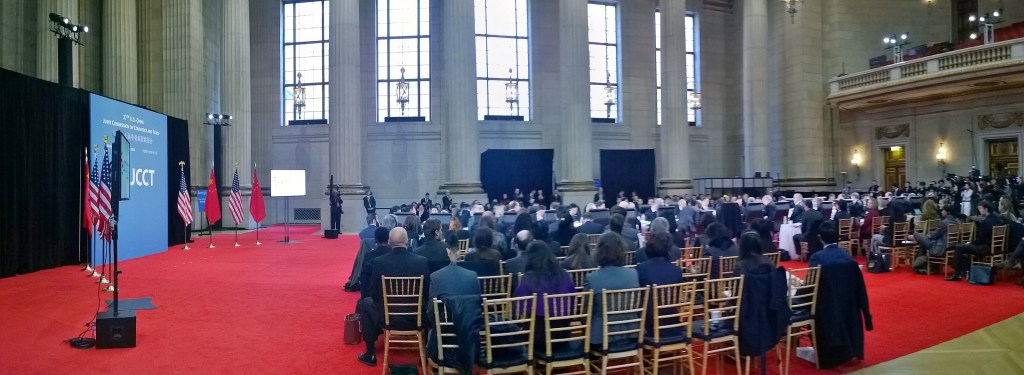
The recently released 2026 National Trade Estimate Report on Foreign Trade Barriers (March 31, 2026) (the “NTE”) provides a useful opportunity to reassess U.S.–China intellectual property negotiations, particularly the Phase One Trade Agreement (2020) as well as the commitments made in the 2016 Joint Commission on Commerce and Trade (JCCT), which is referenced in the NTE, and in which I was directly involved. Many issues identified in the NTE, such as trade secrets, bad-faith trademarks, pharmaceutical IP, and enforcement transparency, were already present in the 2016 JCCT discussions, in addition to earlier bilateral agreements. Comparing these three instruments helps clarify what actually changed, what was repackaged, what was implemented, what remains incomplete, and whether U.S. concerns were properly framed or pursued. Many of these issues are therefore not new, but reflect recurring negotiating patterns and evolving Chinese responses over time.
These documents have several recurring deficiencies. Most importantly, they frequently describe commitments in general terms, such as “China shall enact a measure,” without identifying whether that measure is a statute, State Council regulation, judicial interpretation, or departmental rule, and what agencies will enact or implement the measure. Second, they often fail to distinguish between formal legal adoption and actual implementation, including whether measures are utilized or transparent in practice. The chart below takes a different approach by substituting, where I can, my perspective on what would make the relevant commitment legally enforceable in China, by distinguishing among those forms and types of deliverables. If, for example, the matter involved how patents are examined, an amendment to a patent examination guideline would likely be adequate at least on an interim basis even if it is not legally binding (as in the United States). In most instances, a statute or implementing regulation is required. In addition, if specific behavior may be required of the courts or prosecutors, judicial interpretations or other procuratorial guidance may be necessary. The distinction is based on China’s Law on Legislation and it matters, as lower-level or fragmented measures are not functionally equivalent to binding, system-wide legal change. Secondly, they typically fail to address the utilization of a negotiated reform by foreigners. Thirdly, they also are largely unverifiable due to the relatively low priority placed on transparency of a given reform and its implementation.
The absence of an issue from the NTE, Phase One Agreement, or 2016 JCCT does not indicate that it was not raised elsewhere. These instruments are used here because they are recent and referenced in the NTE, not because they capture the full scope of bilateral IP discussions.
The chart is constructed as follows:
A. Column 1: Briefly describes the issue.
B. Column 2: USTR’s legislative descriptions in the NTE, Phase One Trade Agreement and 2016 JCCT are rephrased for greater accuracy. The type of measure/development is phrased in abbreviated format: AUCL is the Anti-Unfair Competition Law, SPC is Supreme People’s Court (typically a judicial interpretation); SAMR is the State Administration for Market Regulations; CNIPA is the China National IP Administration (responsible for patent and trademark filings), NMPA is the National Medical Products Administration.
C. Columns 6 and 7: My own typology of negotiating responses is used. I have categorized Chinese responses to a U.S. demand by placing these responses in the timeframe of the negotiations. “Regifting” refers to formalizing in bilateral commitments an existing practice (for example, trade secret preliminary injunctions were already available prior to Phase One, including in cases such as Eli Lilly vs. Huang Meng Wei). “Strategic signaling” or just “signaling” refers to visible but partial actions that signal improvement, often in advance of negotiations (for example, publication of trade secret cases on China Judgments Online in 2026 in advance of bilateral meetings). “Wait-it-out” or “ephemeral reform” refers to delayed, lower-level, or reversible measures (for example, departmental rules such as the 2026 SAMR trade secret rules or a short-term administrative campaign or a legislative change without visible implementation). “Short-circuiting” refers to actions likely timed to improve negotiating leverage.
D. Column 8: Discusses the important but largely ignored question of whether foreigners are utilizing these hard-fought improvements to the system. Robust utilization can be an indication that the system is working. On the other hand, under-utilization can be attributable to a range of factors, including weakness in the system, lack of knowledge by rightsholders of the effectiveness of the system, lack of confidence, likelihood of success, discrimination, cost/benefit, etc. Data regarding under-utilization can be developed by comparing different remedies and outcomes.
E. Column 9: Transparency. This issue is only partially addressed by the NTE and may also contribute to low utilization by foreigners of improvements in China’s IP system.
This chart is intended as a working framework, including for possible renewed high-level discussions of trade and intellectual property. Comments and corrections are welcome.
Sources:
USTR, 2026 National Trade Estimate Report (China section).Economic and Trade Agreement Between the United States and China (Phase One, 2020); USTR, 2016 JCCT Fact Sheet.
Mark Cohen, “IPR Model Cases Part of the Long Journey towards IPR Case Law with ‘Chinese Characteristics’” (chinaipr.com Nov. 10, 2013) (discussing the Eli Lilly v Huang Mengwei Preliminary Injunction)
Mark Cohen, “27th JCCT Concludes in DC: Many IPR-Related Outcomes” (chinaipr.com, Dec. 25, 2016)
Mark Cohen, ‘The Phase 1 IP Agreement, Its Fans and Discontents” (chinaipr.com, Jan. 21, 2020).
Mark Cohen, “SAMR’s Trade Secret Rule: An Unchartered Step Forward?” (chinaipr.com, Oct. 16, 2020)
Mark Cohen, “The Cart Before the Horse in China’s Patent Linkage Regime” (chinaipr.com, Oct. 28, 2020)
Mark Cohen, “Synthesizing Developments on Linkage from the July 15 Berkeley Program” (chinaipr.com July 19, 2021)
Mark Cohen, ‘The NTE Report on Chinese IP and Its Relationships to Chinese Legal Developments” (chinaipr.com, Apr. 5, 2021).
Mark Cohen, ‘Post-Filing Data in Chinese Pharma Patents: Why It Took So Long — and What Finally Worked’ (chinaipr.com, Jan. 31, 2026) (discussing post filing data supplementation case of Dec. 31, 2025)
Mark Cohen, “New Trade Secret Protection Rules in China” (chinaipr.com March 12, 2026)
Mark Cohen, “Reading the SPC IP Court’s 2025 Annual Report” (chinaipr.com, 2026).
Mark Cohen, ‘Parallel Play: The Simultaneous Professional Responsibility Campaigns Against Unethical IP Practitioners by the United States and China”, Akron Law Review 56:2 (2023)
Zhao Ye, “Trade Seret Adjudication Trends Of the Supreme People’s Court IP Tribunal (2025” (available at https://www.linkedin.com/posts/ye-zhao-10410410_chinas-trade-secret-enforcement-enters-a-ugcPost-7442209474922164224-53LU?utm_source=share&utm_medium=member_desktop&rcm=ACoAAAF1FYoB56tifp-lv_8rxQTA0BQruVsFjj0)
Categories: JCCT, Pharmaceutical Patents, Phase 1 Agreement, Trade Secret, Trade Secrets

 China IPR - Intellectual Property Developments in China