
The Supreme People’s Court Intellectual Property Court released its 2025 Annual Report in January 2026 (最高人民法院知识产权法庭年度报告). Initial commentary on the Report has emphasized headline themes such as the percentage of foreign-related cases, growth in punitive damages, compensation levels, and the court’s handling of standard-essential patent and competition matters. These themes are broadly consistent with commentary accompanying prior annual reports and are the most self-evident. A deeper analysis requires a closer look at the structure of the Report, what is omitted, issues that have policy or political resonance, and related factors.
This article takes a different approach. Rather than focusing on headline growth figures, it examines some of the underlying data reported by the court, the composition of case categories, and the reporting structure itself. As in prior analyses of earlier annual reports, including my earlier discussion of SPC reporting trends, the discussion below focuses on denominators, category boundaries, and the availability of outcome metrics. The issues discussed include foreign utilization of the civil system, punitive damages as a share of the docket, trade secret cases, criminal referrals, administrative adjudication, and the prominence of plant variety protection.
One important caveat: this appellate court heard 23,069 cases since it establishment out of 496,000 cases heard by the Chinese court system in last year alone. It is the national appellate IP court for technology-related cases, appeals of patent and trademark validity decisions and antitrust appeals.. However, it is not the appellate court for all IP-related cases. Moreover, its data does not reveal the number of technology-related cases heard at lower court levels.
Foreign Participation and Case Composition
The Report states that 16.9% of newly accepted cases involved foreign or Hong Kong/Macau/Taiwan parties. In 2025, the court accepted 2,663 newly accepted cases in 2025, of which 449 involved foreign/HMT parties. Among those 449 cases, 190 were civil matters and 259 were administrative appeals.
Expressed as a share of total newly accepted cases, foreign/HMT civil matters represent approximately 7.1% (190 ÷ 2,663), while administrative matters represent approximately 9.7% (259 ÷ 2,663). Within the foreign/HMT category itself, civil matters account for approximately 42.3% of cases, while administrative matters account for approximately 57.7%.
These data show that foreign participation continues to be much more concentrated in administrative authorization and validity appeals than in civil infringement litigation appeals. This pattern is consistent with longer-term trends in China’s judicial IP system, where foreign parties have historically have disproportionately participated in trademark and patent validity matters, rather than in civil litigation. I have previously interpreted this general inconsistency as an indicator that foreigners believe it is more necessary to secure rights than to litigate their infringement. Such a decision may be due to foreign recognition that it is more critical to obtain a patent or trademark right over the long term, and a hope that China’s system will evolve to the point where they have greater confidence in the civil system to address more temporal infringements. The data needs to be compared with first instance data on foreign participation in the civil system and administrative appeals to further determine whether there has been more active participation by foreigners in the infringement litigation over the years.
Punitive Damages
The Report highlights the application of punitive damages in selected cases. However, the Statistical Appendix indicates that punitive damages cases appear to constitute well under 1% of newly accepted appellate cases in 2025.
This suggests that while punitive damages remain an available and increasingly referenced remedy, they represent a small fraction of total case volume, particularly on an appellate level. Once again, the data needs to be compared with national level civil infringement data to determine the extent of punitive damage awards beyond the appellate level.
Trade Secret Cases
The Report states that since the court’s establishment in 2019, it has accepted 343 technical secret/trade secret infringement cases, of which 334 have been concluded, including 51 in 2025. Trade secrets apparently have retained their status as a small percentage of the appellate docket, and most likely the trial court dockets. Last year was about an average year in numbers of trade secret cases for the court. Low utilization of trade secret remedies may be attributable to many factors, including evidence gathering, risks of secondary disclosure through initiation of a court proceeding and a low likelihood of success. Moreover, considering the great attention paid to technical trade secrets in the Trump Trade War, the system still seems to be little used by foreign and domestic rightholders. As I noted at the time of the Phase One Agreement, the “US did not push for increased transparency of trade secret cases so data will be limited and difficult to reconcile.” The administrative system likely suffers from similar problems of low utilization.
The published data also provides limited information on case volume but not on outcome metrics, such as success rates, preliminary injunction rates, or transfers to criminal prosecution.
Criminal Referrals
The Report notes that the court transferred 17 suspected illegal or criminal leads to investigative authorities in 2025. This indicates that referral to investigative authorities forms part of the broader enforcement framework described in the Report with little further elaboration. It is a bit concerning that cases of suspected criminality are being transferred at an appellate level and not at the trial court level. Additional information on the referall process at the trial and appellate levels would be useful, including information on the types of infringement which were referred to criminal prosecution.
Judicial Review of Administrative Matters
The Statistical Appendix reports 42 “administrative adjudication and similar disputes” in 2025 and 455 cumulatively since 2019. The Report does not provide a consolidated reversal or modification rate for administrative penalty decisions within the broader administrative enforcement system. The data presented therefore identify case counts but do not include detailed outcome breakdowns for administrative penalty appeals.
Plant Variety Protection
Although plant variety protection is not a major part of Chinese IP litigation or one that has been subject to repeated US government requests, I often look to it to get a sense of how China is handling forms of IP protection which are not subject to significant US engagement but which are nonetheless important to U.S. industry. Justice Tao Kaiyuan and Judge He Zhonglin in discussing the Report, noted that since the court has been established, it has handled 481 cases involving new varieties of plants, and it had concluded 364 of these cases, with an 80% win rate. The Report notes that there have been 14 administrative plant variety cases (Section 3.1 of Statistical Annex) and 842 civil cases since the court’s establishment (Section 2.1 of the Statistical Annex) with a 90% success rate (Repot, p. 4), which likely reflect different categories or perhaps inaccurate reporting. The data nonetheless suggests that plant variety disputes occupy a limited but growing quantitative share of the overall docket that is of continuing importance to China, which likely hears the most plant variety cases in the world. This is an observation that I shared in a blog on one recent administrative plant variety protection penalty appeal.
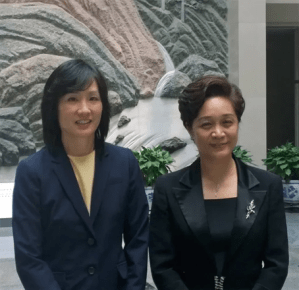
Former USPTO Director Michelle Lee with Justice Tao Kaiyuan (photograph by the author)
Conclusion
The Report provides detailed statistical information across multiple categories. A close reading shows that headline percentages depend on category composition, that certain remedies represent only a small share of total case volume, and that volume data are not always accompanied by outcome metrics. Notwithstanding its limitations, it the Report supplies a substantial quantitative foundation for reviewing the docket of this court and for analyzing what the data suggests concerning China’s national IP docket.
The Report also reminds me that we need to do better in understanding how these reports are structured and what they are designed to convey. In that sense, the Report invites a reading at a literal level, but also, to borrow a term used in biblical analysis, as a drash (דְּרַשׁ). A drash is an interpretive exercise attentive to how meaning is constructed and communicated. Its deeper significance emerges through inquiry, comparison with other data, and attention to how it is presented to an audience, including its homiletic or persuasive dimensions. That deeper reading complements, rather than replaces, the Report’s still useful surface meaning. This post examines the SPC IP Court’s 2025 Annual Report by focusing on underlying data, case composition, and reporting structure rather than headline claims. It shows that foreign participation is concentrated in administrative appeals, that punitive damages and trade secret cases remain a small share of the docket, and that plant variety protection is receiving increased attention. The post argues that careful attention to denominators, omissions, and how data are presented is necessary to understand what the Report actually shows.
Categories: China IPR, Phase 1 Agreement, SPC, SPC White Paper, Statistics, Trade Secrets, UPOV

 China IPR - Intellectual Property Developments in China