
In memory of Ronald Cohen, born August 27, 1926.
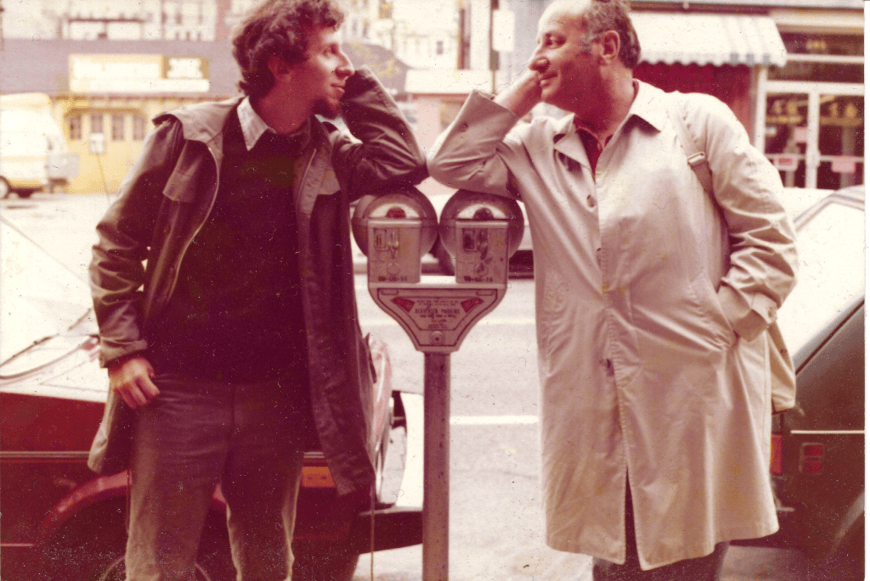
(My father and me in Greenwich Village, during his years as a graduate student at NYU.)
My father, Ronald Cohen, was born on August 27, 1926. On what will soon be his hundredth birthday, I find myself thinking about two innovations of his, and about how long it took me to understand how much I followed him.
When I was young, I intended to follow Dad into public health. In fact, I wanted to go one better: I would become a physician as well as a public health officer. One of my heroes was Rear Admiral Jerrold Michael, M.D., who served as Assistant Surgeon General of the United States and later as Dean of the School of Public Health at the University of Hawaii. Dad proudly told him that someday I would outdo him as the future Surgeon General. Public health was part of the world in which I grew up.
Dad’s professional title early in his career was “sanitarian.” Even then, I thought the title was unfortunate, rather like a rubbish man with a graduate degree. It meant considerably more than that. In the days of the Jewish numerus clausus, Dad was first in his class at Columbia’s School of Pharmacy, earned a master’s degree in pharmacy, and taught organic chemistry at Columbia. He later received an M.P.H. from Columbia’s School of Public Health and a Ph.D. in public health administration from New York University. He believed that medical school was out of reach.
As a New York City sanitarian, his laboratory was the city itself. As one of his jobs, he inspected tenements in Hell’s Kitchen. Among the hazards he encountered was carbon monoxide poisoning from gas appliances. It was during these years, while Dad was also in graduate school in the early 1950s, that he told me he conceived a solution to the problem. If a chimney or flue became blocked and dangerous combustion gases backed up into an apartment, why couldn’t the heater detect the condition and shut itself off? Dad and a coinventor developed a blocked-flue safety control to do just that.
After a subsequent meeting with the New York City Health Commissioner, the City decided not to seek a patent. As Dad remembered it, the decision reflected the mistaken belief that a patent would principally serve as a means of collecting royalties. One major U.S. company nonetheless expressed an interest, and the technology was made available to it and marketed without identifying the inventors.
For Dad, that missed another important function of the patent system: attribution. A patent identifies its inventors and places their contribution in a permanent public record and in the sequence of improvements to the constitutional “useful Arts.” Dad wanted his invention used to protect people. He also wanted recognition for having invented it.
About a decade after Dad developed the blocked-flue control, in 1962 Dad, Benjamin L. Novak and Epifanio Sineno, published “A New Method for the Prevention of Carbon Monoxide Poisoning.” The article describes the invention and its operation with unusual specificity, with accompanying engineering diagrams and its incorporation into a municipal standard. Reading it now as an intellectual property lawyer, its presentation strikes me as distinctly patent-like.
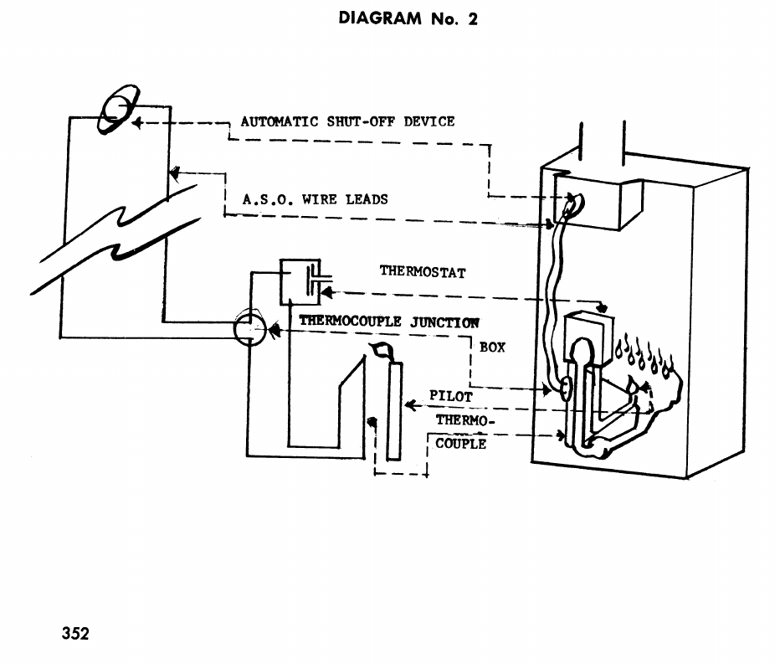
Diagram No. 2 from “A New Method for the Prevention of Carbon Monoxide Poisoning” (1962). Source: Cohen, Novak & Sineno, 1962
The authors described their principal contribution as their “pioneering with the blocked flue safety control.” Knowing how much attribution mattered to Dad, I now believe that the article was in part an effort to create the public record that the City’s decision not to patent had denied him 10 years earlier. The article also documented what was happening to carbon monoxide poisonings from gas space heaters as a result of his invention. Among unapproved gas space heaters, reported carbon monoxide incidents declined from 17 in 1956 to two in 1960. Fatalities declined from seven to zero, while the total number of persons poisoned declined from 40 to four. Dad had developed the blocked-flue control before using the device was adopted into New York City law. The 1956–1960 figures therefore do not capture the full decline from the period before Dad developed the invention.
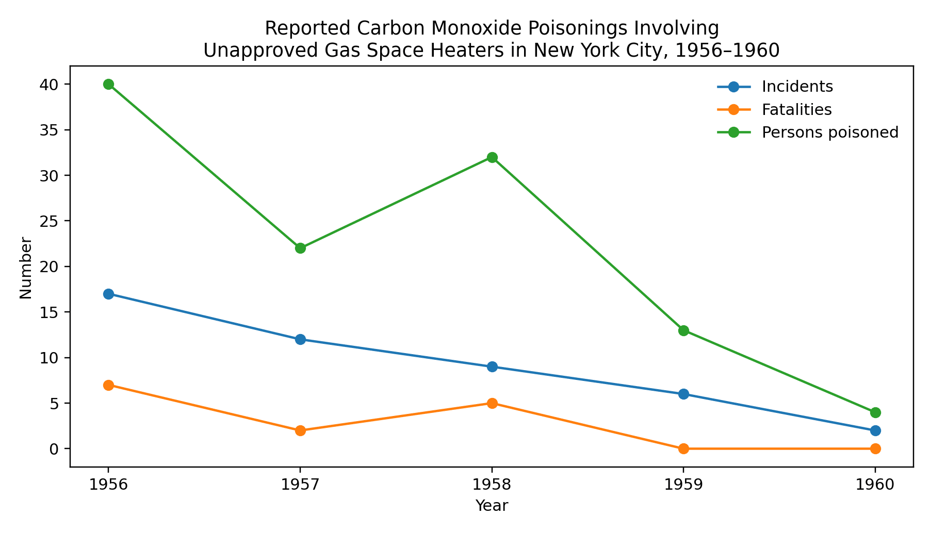
Reported Carbon Monoxide Poisonings Involving Unapproved Gas Space Heaters in New York City, 1956-1960. Source: Ronald Cohen, Benjamin L. Novak & Epifanio Sineno, 1962.
The evidence concerning approved heaters was even more striking. After NYC Local Law 79 was enacted in December 1957, thousands of approved gas-fired space heaters were installed in multiple dwellings. Dad and his colleagues reported that “not a single case” of carbon monoxide poisoning was attributable to an approved gas-fired space heater.
When I later taught Chinese intellectual property law at Fordham Law School, adjacent to Hell’s Kitchen in New York City, I told my students about Dad’s invention of the flue-gas control device. It was in the largely Irish Catholic tenements of that neighborhood that Dad had encountered the CO problem he sought to solve.
Later, in 1984, Dad and his colleagues in Middlesex Borough, New Jersey, developed a system to address hazardous-materials incidents. Using a desktop computer and a CB radio system, it provided information about industrial facilities and hazardous materials in advance so that emergency responders could obtain it immediately when an incident occurred. It was also designed to connect through the New Jersey State Police to FEMA.
Dad and his colleagues were creating an emergency-response network before the World Wide Web existed. The network was tested during three major emergencies in 1985. After an explosion at a chemical plant, responders had information on chemical storage, tanks, utilities, hydrants, drainage, protective equipment, and a computerized diagram of the plant. Dad wrote that this allowed them to make “real and rapid decisions” without second-guessing. The information helped the fire chief direct resources toward the greatest risks, prevent underground solvent tanks from exploding, and limit environmental damage.
Looking back at Dad’s inventions, I understand my father’s influence differently from when I was young. In that photo of the two of us meeting after his class at NYU, it looks like we are on opposite sides. In fact, we weren’t. Dad taught me that innovation begins with seeing real problems that others have learned to tolerate. He taught me to solve these problems. He taught me to persist, even if that initial recognition passed you by. He even taught me about the importance of patents, and the recognition that a patent carries, even for a government inventor.
Our professions were different, but I have followed my father after all.
Sources: Ronald Cohen, Benjamin L. Novak & Epifanio Sineno, “A New Method for the Prevention of Carbon Monoxide Poisoning,” Sanitarian, Vol. 24 (1962), pp. 350–353, https://www.jstor.org/stable/44512952; and Ronald Cohen, “Computerized Data Enhance Hazardous Materials Incident Response,” Journal of Environmental Health, Vol. 49, No. 2 (September/October 1986), pp. 69–71.
The photograph is (c) Mark A. Cohen, all rights reserved.
Categories: Bayh-Dole, Birch Bayh, Government & Regulations, New York CIty, Patent


Your touching story reminded me. My late father was an engineer who worked in the 1950s for the UK company Imperial Chemical Industries . We knew, as children, of his involvement in developing polythene and consumer plastics. I was an intellectual property academic who helped pioneer (with the initial help of the UKIPO) in the late 1980s/early 1990s teaching IPR to creators in IP rights. My father sat through my professorial inaugural lecture with obvious pride. I might not have followed him into engineering, but he could identify with my enthusiasm. When both my parents had died and the house was cleared for sale, I lay claim to a poorly framed print that I had always liked. My husband, whose career was a million miles from IP or engineering, offered to take it to be reframed. He stood and watched as the framer took the frame apart. It had been a botched job by my dad. As the framer removed the old newsprint and other stuffing behind the print, my husband spotted something he thought he recognised, and asked for it to be given to him. He returned home, with the newly beautifully framed print , and a copy of a patent. Named as one of two inventors for a development in consumer plastics was my father. I was gobsmacked. A data search revealed he is named on two other patents. WHY had he never during his lifetime said he was an inventor with patents? WHY had he not understood how I’d have liked to use the specifications as teaching materials? WHY had he not appreciated how interesting and helpful I’d have found gleaning his first hand lived experience of empoyee patenting? WHY oh WHY?
LikeLike
Thanks for this. My father was rather similar. I only learned when he was near death of his efforts to secure a patent for his invention and a meeting with the NYC health commissioner. It was obvious then why that article was so important to him- it was the only record of an accomplishment he had made at the very beginning of a long career – and it was an accomplishment that distinctly belonged to him and a co-inventor. My brother and I only knew half the story, about his invention and lives it saved. They didn’t know the other part about his frustration – which I think ultimately led him to leave the NYC Department of Health. I remember too one time that Dad met Jerry Lemelson (a rather ‘notorious’ independent inventor) – perhaps 25 years ago. We were walking in a park together – and I knew Jerry through my wife’s contacts. The two of them walked together, and I always wondered what they talked about They are both gone – but at least I like to think that the reason they seemed to get along was their inventive spirit.
LikeLike
Wonderful, Mark. So glad you wrote this. With advanced age, I have spent a lot of brain power thinking about and re-evaluating my own father. Perhaps the subject for another lunch!
B.
On Sat, Aug 22, 2026 at 2:25 PM China IPR – Intellectual Property Developments
LikeLike